

Floyd Mayweather Jr. is one of the most recognizable names in modern boxing. Known for his perfect professional record, defensive brilliance, extravagant lifestyle, and business-minded approach to boxing, he has built a financial legacy that goes far beyond prize money. But how much is Floyd Mayweather actually worth?
That question is surprisingly difficult to answer. Public estimates vary widely, and career earnings are not the same thing as personal wealth. Mayweather has earned enormous sums from pay-per-view events, promotions, endorsements, appearances, and exhibitions, while taxes, spending, investments, debts, legal disputes, and asset values can all affect the amount he ultimately retains.
As of 2026, published estimates differ substantially. Celebrity Net Worth has reported a much lower current estimate while also stating that Mayweather’s career earnings have exceeded $1 billion. Forbes, meanwhile, has documented some of the extraordinary individual paydays that helped create his fortune, including $275 million from his 2017 fight with Conor McGregor.
So, rather than treating one online number as unquestionable, it is more useful to understand how Mayweather made his money, what contributed to his wealth, and why estimates can change.
Who Is Floyd Mayweather?
Floyd Joy Mayweather Jr. was born on February 24, 1977, in Grand Rapids, Michigan. Boxing was already deeply connected to his family. His father, Floyd Mayweather Sr., was a professional boxer and trainer, while his uncles Jeff and Roger Mayweather also had careers in the sport.
Growing up around boxing gave Mayweather an early understanding of what it took to compete at the highest level. He developed into an accomplished amateur and represented the United States at the 1996 Olympic Games in Atlanta, where he won a bronze medal.
That Olympic experience became the beginning of a professional career that would eventually transform him into one of the highest-earning athletes in sports history.
Mayweather turned professional in 1996 and quickly developed a reputation for speed, accuracy, defensive movement, and ring intelligence. Instead of relying primarily on raw power, he often won by making opponents miss, controlling distance, and scoring efficiently.
His nickname, “Money,” eventually became more than a promotional slogan. It reflected the business strategy that came to define his career.
How Mayweather Built His Fortune Through Boxing
For most professional boxers, the biggest source of income is the fight purse. Mayweather took that model much further.
He became particularly skilled at negotiating lucrative pay-per-view arrangements. Rather than simply accepting a fixed amount to fight, he increasingly positioned himself as the central attraction and sought a substantial share of the event’s revenue.
That distinction matters.
Imagine a musician performing in a stadium. One artist might receive a fixed performance fee. Another might negotiate a percentage of ticket sales, merchandise, broadcasting, and other revenue. Mayweather increasingly operated more like the second example.
His financial strategy involved controlling his own promotion, building his personal brand, and maximizing his share of major events.
This approach produced enormous paydays.
His fight against Oscar De La Hoya in 2007 became a major commercial event. Later contests against Ricky Hatton, Miguel Cotto, Canelo Alvarez, and Manny Pacquiao generated enormous interest.
But two fights stand out above almost everything else: Manny Pacquiao in 2015 and Conor McGregor in 2017.
The Manny Pacquiao Fight and Its Massive Revenue
The long-awaited Mayweather-Pacquiao fight took place in Las Vegas on May 2, 2015.
For years, boxing fans had wanted to see the two superstars compete. By the time the fight finally happened, it had become one of the biggest sporting events in history.
The financial numbers were extraordinary.
The event generated hundreds of millions of dollars in revenue, driven largely by pay-per-view purchases, ticket sales, international broadcasting, sponsorships, and related commercial activity.
Mayweather’s share was enormous, helping establish him as one of the rare athletes capable of generating nine-figure earnings from a single sporting event.
The fight also demonstrated an important part of his financial formula: the value of an event increases when the athlete controls a large portion of the economic upside.
Mayweather was not merely selling his ability to box. He was selling an entire entertainment experience built around his personality, undefeated record, opponent, promotion, and global audience.
That distinction became even more important two years later.
The Conor McGregor Fight Changed the Financial Conversation
If one fight best illustrates Mayweather’s business instincts, it may be his 2017 bout against UFC superstar Conor McGregor.
At first, the matchup sounded almost impossible. Mayweather was an elite professional boxer, while McGregor was one of mixed martial arts’ biggest stars.
Yet the unusual nature of the contest generated enormous public curiosity.
The fight eventually took place in August 2017 and became a financial phenomenon.
Forbes reported that the event produced more than $550 million in total revenue and 4.3 million pay-per-view purchases. Mayweather earned an estimated $275 million from the fight, while his overall earnings for the year reached approximately $285 million when other income was included.
Forbes also reported that Mayweather’s career earnings reached approximately $1 billion following the McGregor fight.
This was one of the most remarkable single-event earnings achievements in sports.
It also explains why discussions about his wealth often involve very large numbers.
Why Career Earnings Are Not the Same as Net Worth
This is one of the most important points to understand when discussing Mayweather’s finances.
Someone can earn $1 billion over a lifetime without having $1 billion sitting in a bank account.
Think of career earnings as everything that has flowed into a business over many years. Net worth is what remains after considering assets and liabilities.
For a simplified example, suppose someone earns $100 million. They may then pay taxes, management fees, legal expenses, training costs, business expenses, property costs, and other bills. They might also purchase homes, cars, aircraft, jewelry, and investments.
Their bank balance obviously would not equal their total lifetime income.
Mayweather’s situation is considerably more complicated because he has earned money across multiple decades and has owned or invested in different types of assets.
Therefore, statements such as “Mayweather earned more than $1 billion” should not automatically be interpreted as “Mayweather currently has $1 billion in cash.”
That distinction is crucial.
His Promotion Business and the “Money” Brand
Mayweather’s financial success was not based solely on punching opponents.
He became increasingly involved in promotion and branding through Mayweather Promotions.
This allowed him to participate in the business side of boxing and helped create opportunities beyond his own fights.
His personality was also a major commercial asset.
Mayweather understood that controversy attracts attention. His extravagant spending, designer clothing, jewelry, cars, private aircraft, and public displays of wealth became part of his image.
Whether people admired him or disliked him, they continued talking about him.
In entertainment, attention has economic value.
Mayweather turned that attention into pay-per-view purchases, ticket sales, sponsorship opportunities, media appearances, and promotional value.
Forbes reported that his 2017–2018 earnings included approximately $10 million from appearances, memorabilia, and endorsements in addition to his boxing income.
That shows how the Mayweather brand extended beyond the boxing ring.
Real Estate, Cars, Jewelry and Private Aircraft
Mayweather has long been associated with luxury possessions.
His publicly displayed lifestyle has included expensive vehicles, high-end watches, jewelry, mansions, and private aircraft.
These possessions can represent wealth, but they also demonstrate why calculating a celebrity’s net worth can be complicated.
A luxury watch might be worth millions, for example, but its resale value can change. A property might appreciate over time, but it can also carry mortgages, taxes, maintenance costs, or other financial obligations.
Mayweather has also discussed real-estate investments and commercial property ventures. However, some claims about the size and structure of his property holdings have been disputed publicly, making it important to distinguish between confirmed ownership and promotional statements.
His private aviation has also attracted attention. His aircraft and travel habits have become part of the larger “Money” image that surrounds him.
The same applies to his jewelry collection. Expensive watches and diamond-covered pieces are frequently associated with Mayweather’s public persona.
Endorsements and Business Income
Although boxing has generated the overwhelming majority of Mayweather’s fame and fortune, outside income has also contributed to his financial picture.
He has earned money through sponsorships, endorsements, appearances, merchandise, promotional activity, and business ventures.
However, Mayweather has historically been different from many other superstar athletes.
Some athletes build enormous fortunes through long-term endorsement contracts with global corporations. Mayweather’s strongest financial engine was usually his own name and his ability to generate revenue from major boxing events.
Forbes’ 2018 figures illustrate this difference. It estimated Mayweather’s total earnings at $285 million for the relevant year, with $275 million coming from salary and winnings and about $10 million from endorsements and related income.
That tells us something important about his career.
He did not need a huge collection of traditional sponsorships to become one of the world’s highest-paid athletes. His fights themselves were the primary business.
The Role of Taxes, Spending and Financial Obligations
Large income does not eliminate financial responsibilities.
Athletes at Mayweather’s level can face substantial federal and state taxes, business expenses, professional fees, insurance, property costs, staff expenses, and other obligations.
Mayweather has also become known for extraordinary spending.
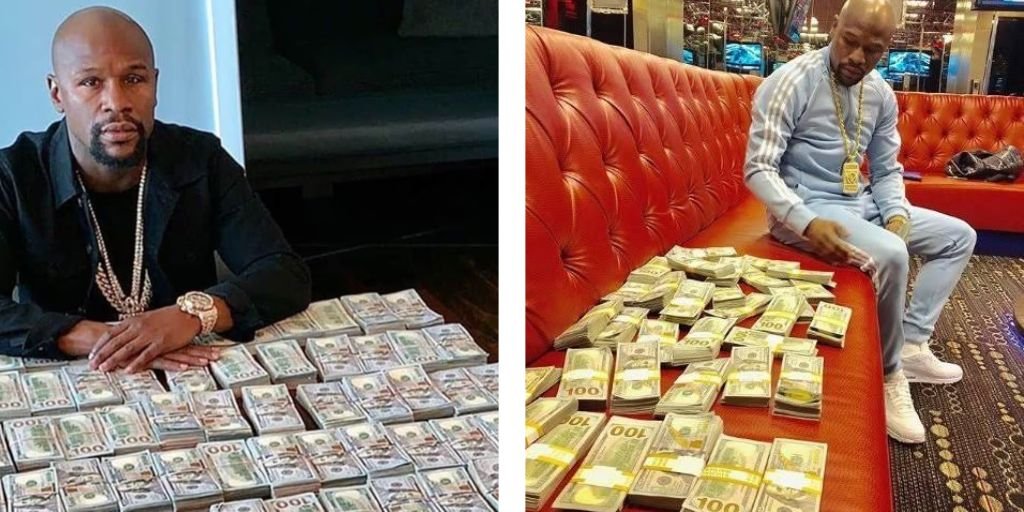
His social media presence has frequently shown luxury purchases and large amounts of cash. Such displays have become a central part of his public image.
But lifestyle spending can make wealth difficult to measure.
Someone who owns several expensive houses, vehicles, aircraft, watches, and jewelry may have substantial assets but also significant costs associated with maintaining them.
Similarly, an investment portfolio may contain valuable assets while remaining difficult for outsiders to evaluate accurately.
This is why a celebrity net worth figure should generally be treated as an estimate, not a verified bank statement.
Why Estimates of Mayweather’s Net Worth Vary So Much
Search for Mayweather’s wealth online and you will quickly discover different numbers.
Some websites have previously estimated his wealth in the hundreds of millions of dollars. Other recent reports have offered substantially lower figures. Celebrity Net Worth, for example, published a 2026 estimate of $50 million while also reporting career earnings of more than $1.2 billion.
Another 2026 report from the same publication later described its own estimate as approximately $100 million and emphasized the uncertainty surrounding his finances.
Why such a huge difference?
Because there is no public, independently audited balance sheet showing all of Mayweather’s assets, debts, investments, cash holdings, business interests, and obligations.
Recent legal disputes have added another layer of uncertainty.
In 2026, Mayweather filed lawsuits making major financial allegations involving past earnings and alleged misappropriation of money. The claims remain legal allegations rather than established facts, and the defendants have disputed them.
This is precisely why responsible reporting should avoid presenting an uncertain estimate as an unquestionable fact.
Mayweather’s Legacy as a Financial Athlete
Mayweather’s financial influence on boxing may ultimately become almost as interesting as his sporting achievements.
He showed fighters that they could think of themselves as businesses rather than simply athletes.
His career helped popularize a model based on:
- Personal branding
- Pay-per-view control
- Event promotion
- Revenue sharing
- Social media attention
- Strategic matchmaking
- Direct audience engagement
- Business ownership
Of course, not every boxer can replicate this formula.
Mayweather had extraordinary circumstances working in his favor. He was undefeated, highly skilled, famous worldwide, and capable of generating enormous controversy and interest.
Still, his example changed how many athletes thought about their economic value.
He understood something simple: the person who controls the audience often has greater negotiating power.
That lesson extends well beyond boxing.
What Mayweather’s Wealth Says About Modern Sports
Mayweather’s financial story also reflects how professional sports have changed.
In earlier generations, athletes were often primarily paid salaries or fixed purses. Today, elite performers can generate income through broadcasting rights, streaming, sponsorships, digital content, licensing, social media, and direct-to-consumer entertainment.
Boxing is especially unusual because the biggest stars can participate directly in the economics of a major event.
Mayweather took advantage of that structure better than almost anyone.
Forbes recognized him as the world’s highest-paid athlete four times in seven years by 2018.
His 2017 fight with McGregor alone illustrates the scale. Forbes reported that Mayweather earned $275 million from the contest and that the event generated more than $550 million in total revenue.
Those numbers help explain why he became synonymous with financial success in boxing.
Conclusion
Floyd Mayweather’s financial story is far more complicated than a single net-worth number. His professional career generated extraordinary income, including some of the largest fight paydays ever recorded. Forbes documented his $275 million payday against Conor McGregor and reported that his career earnings had reached roughly $1 billion by 2018.
At the same time, current estimates of his personal wealth vary dramatically. Recent financial disputes, legal claims, investments, spending, assets, and liabilities make it difficult for outsiders to determine his exact position in 2026.
What is much easier to establish is Mayweather’s impact. He transformed himself from an elite boxer into a global sports brand and business personality. His undefeated record created the foundation, but his understanding of promotion, attention, and revenue turned that foundation into extraordinary financial success.
Ultimately, his story is a reminder that earning money and keeping wealth are two different games. Mayweather mastered the first on a historic scale; understanding the second requires looking beyond the flashy lifestyle and examining the complicated financial picture behind it.
FAQs
1. What is Floyd Mayweather’s net worth?
There is no universally verified public figure for Floyd Mayweather’s current net worth in 2026. Published estimates vary considerably. Celebrity Net Worth has offered estimates ranging from $50 million to around $100 million in recent 2026 reporting, while also noting that Mayweather’s lifetime earnings have exceeded $1 billion.
2. How much money did Floyd Mayweather make from boxing?
Mayweather has generated more than $1 billion in career earnings according to Forbes and other published estimates. Forbes reported that his 2017 fight against Conor McGregor alone produced an estimated $275 million payday for Mayweather.
3. What was Mayweather’s biggest fight payday?
His fight with Conor McGregor in 2017 was among his largest individual paydays. Forbes estimated Mayweather’s earnings from the event at approximately $275 million.
4. Did Floyd Mayweather become a billionaire?
Mayweather has generated more than $1 billion in career earnings, but that does not automatically mean he has a billion-dollar personal net worth. Career income, taxes, spending, investments, debts, and asset values are all different components of personal wealth.
5. Why are estimates of Mayweather’s wealth so different?
The main reason is that Mayweather’s complete financial records are not publicly available. His assets, investments, business interests, liabilities, legal disputes, and spending can change over time. Consequently, websites use different assumptions when calculating an estimated net worth.
