

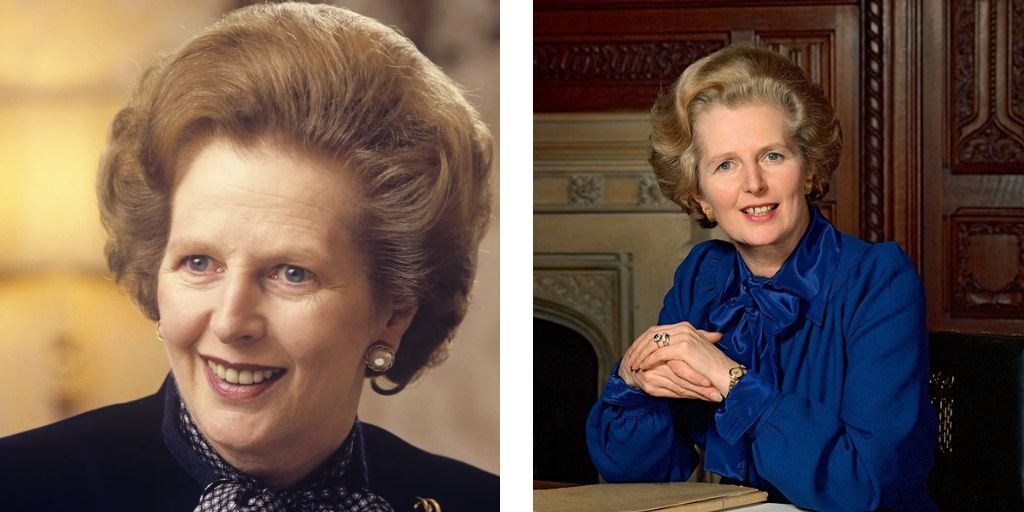
Margaret Thatcher remains one of the most influential and controversial political figures of modern British history. Known as the “Iron Lady,” she became the first woman to serve as Prime Minister of the United Kingdom and held the office from 1979 to 1990. Her years in government transformed Britain’s economy, reshaped its relationship with trade unions, and changed the direction of Conservative politics for decades.
But who was Margaret Thatcher beyond the famous speeches, political battles, and strong public image? Her story began far from Westminster, in a modest family in Grantham. Through determination, education, and political ambition, she eventually reached the highest political office in Britain.
Her legacy is complicated. Supporters credit her with revitalizing a struggling economy, encouraging private enterprise, and strengthening Britain’s international position. Critics argue that her policies increased inequality, weakened industrial communities, and caused serious social disruption. Understanding her life therefore requires looking at both sides of the story.
Early Life and Family Background
Margaret Hilda Roberts was born on 13 October 1925 in Grantham, Lincolnshire, England. She grew up in a family where discipline, hard work, and personal responsibility were taken seriously.
Her father, Alfred Roberts, was a grocer and local politician. He was also involved in community affairs and served as a Methodist lay preacher. His example had a major influence on Margaret’s character. From an early age, she was exposed to ideas about responsibility, independence, thrift, and public service.
Her family did not belong to Britain’s traditional political elite. That is important when considering her later career. Thatcher did not begin life surrounded by aristocratic connections or inherited political power. Instead, she came from a small-business background and developed an intense belief in self-reliance.
Education was another major part of her upbringing. She attended Kesteven and Grantham Girls’ School before winning a scholarship to Somerville College, Oxford, where she studied chemistry.
At Oxford, she developed an interest in politics and became active in the Conservative Association. Her scientific education also shaped the analytical approach she later brought to political questions.
Her early years were therefore a mixture of science, family discipline, religion, community involvement, and political curiosity. These experiences became part of the foundation for the worldview she carried throughout her career.
From Chemistry to Politics
After graduating from Oxford, Thatcher initially worked as a research chemist. She held positions in industry and developed practical experience in scientific work.
Yet politics remained an important ambition. In 1950 and 1951, she stood unsuccessfully as a Conservative candidate in Dartford. Although she lost both elections, the experience gave her valuable exposure to campaigning and public speaking.
Her persistence eventually paid off.
In 1951, she married Denis Thatcher, a successful businessman. Their marriage provided personal support while Margaret continued pursuing her political ambitions. The couple later had twins, Mark and Carol, born in 1953.
During this period, Thatcher also studied law and qualified as a barrister, specializing in taxation. This combination of science, law, business exposure, and political experience gave her an unusually broad professional background.
In 1959, she won election as the Conservative Member of Parliament for Finchley. This was the beginning of a parliamentary career that would eventually take her to Downing Street.
Her rise was not immediate. British politics in the 1960s remained heavily dominated by men, and the Conservative Party itself had a deeply established hierarchy. Thatcher had to establish herself in an environment where female politicians faced significant barriers.
She gradually gained attention for her determination, preparation, and willingness to take strong positions.
Rise Within the Conservative Party
Thatcher entered government in 1970 when Prime Minister Edward Heath appointed her Secretary of State for Education and Science.
Her time in the department became controversial. One decision in particular attracted intense criticism: the government ended free school milk for some older children in England. Opponents gave her the insulting nickname “Margaret Thatcher, Milk Snatcher.”
The episode demonstrated an important feature of her political career. Thatcher was prepared to defend unpopular decisions if she believed they were financially or philosophically justified.
Her political views also evolved during the 1970s. She became increasingly critical of government intervention, excessive taxation, powerful trade unions, and the influence of socialist ideas.
In 1975, Thatcher challenged Edward Heath for the leadership of the Conservative Party. Few expected her to defeat him.
She did.
Her victory made her the first woman to lead the Conservative Party and one of the most prominent female politicians in the Western world.
The political climate was changing rapidly. Britain was experiencing inflation, labor disputes, economic difficulties, and uncertainty about its future. Thatcher presented herself as a politician willing to challenge established assumptions.
Her message was simple but powerful: Britain needed to become more competitive, productive, and economically independent.
Becoming Britain’s First Female Prime Minister
The general election of 1979 became a defining moment.
The Conservative Party campaigned on promises to reduce inflation, control government spending, strengthen individual responsibility, and reform industrial relations. The Labour government under James Callaghan was struggling amid economic and industrial difficulties.
The Conservatives won the election, and on 4 May 1979, Margaret Thatcher became Prime Minister.
Her achievement was historic.
No woman had previously served as Britain’s prime minister. Thatcher’s arrival at Downing Street represented a major milestone for women in British political life, even though her own political philosophy did not center on modern feminism.
She quickly established a reputation for being highly disciplined and demanding. Cabinet colleagues understood that she expected detailed preparation and strong arguments.
Her style was sometimes described as uncompromising. To supporters, that quality demonstrated leadership. To opponents, it could appear inflexible.
Either way, Britain had entered a new political era.
Economic Policies and the Transformation of Britain
Economic policy became the central feature of Thatcher’s government.
When she took office, Britain faced high inflation, weak productivity, industrial unrest, and concerns about economic competitiveness. Thatcher believed that the state had become too involved in the economy and that individuals and businesses needed greater freedom.
Her government introduced policies associated with monetarism, tax reform, deregulation, privatization, and reduced government intervention.
One major objective was to control inflation. Interest rates were raised significantly, while government spending was constrained. These measures contributed to a severe recession in the early 1980s.
Unemployment rose sharply, and many traditional manufacturing industries suffered.
For communities dependent on factories, steelworks, shipyards, and coal mines, these changes could feel devastating. Economic restructuring was not an abstract idea for these families. It could mean losing a job, seeing a local business close, or watching a familiar community decline.
At the same time, Thatcher’s supporters argued that painful reforms were necessary to create a more productive and flexible economy.
Her government also reduced income tax rates, particularly on higher earners, while increasing indirect taxation. The philosophy was that people should have stronger incentives to work, invest, and build businesses.
This approach became closely associated with what is now commonly called Thatcherism.
An easy way to understand Thatcherism is to imagine Britain as a large ship that had become slow and difficult to steer. Thatcher believed the government had added too much weight to the ship. Her solution was to remove some of that weight and give private enterprise a larger role.
Whether that solution improved the ship or created new problems remains a subject of debate.
Privatization and the Growth of Home Ownership
One of the most visible elements of Thatcher’s economic program was privatization.
State-owned companies and industries were sold to private investors. Major enterprises associated with telecommunications, gas, electricity, and other sectors eventually moved from public to private ownership.
The government argued that privatization would increase efficiency, encourage competition, reduce the state’s financial burden, and allow ordinary citizens to become shareholders.
Millions of shares were marketed to the public, helping create a wider culture of individual investment.
Another major policy involved council housing.
Thatcher’s government expanded the Right to Buy program, allowing many council tenants to purchase their homes at substantial discounts. For families who had never imagined owning property, the policy could be transformative.
Supporters saw it as an expansion of personal independence and property ownership. Critics argued that the policy reduced the supply of affordable public housing and contributed to long-term housing problems.
Both perspectives help explain why Thatcher’s housing reforms remain politically significant.
For some people, her government opened the door to property ownership. For others, it marked the beginning of a decline in social housing provision.
Trade Unions and the Miners’ Strike
Thatcher’s relationship with Britain’s trade unions was one of the most important political conflicts of the 1980s.
She believed powerful unions had become capable of disrupting the economy and challenging elected governments. Her administration therefore introduced legislation designed to limit union power and change the rules governing industrial action.
The confrontation reached its peak during the 1984–1985 miners’ strike.
The National Union of Mineworkers opposed plans to close unprofitable coal mines. The strike became a bitter national conflict involving miners, police, communities, politicians, and supporters on both sides.
The dispute lasted approximately a year and ended with the miners returning to work without achieving their central objectives.
The consequences were enormous.
Mining communities across Britain experienced economic and social hardship. Some communities never fully recovered from the decline of the industry.
Supporters of Thatcher believed the government had finally broken a pattern of union power that had contributed to Britain’s economic instability. Critics saw the miners’ defeat as an example of the government ignoring working-class communities.
The strike remains one of the clearest symbols of the divisions created by Thatcher’s policies.
The Falklands War and International Leadership
In April 1982, Argentina invaded the Falkland Islands, a British overseas territory in the South Atlantic.
Thatcher’s government responded by sending a British military task force thousands of miles to recover the islands.
The conflict lasted roughly ten weeks and ended with the surrender of Argentine forces in June 1982.
The British victory dramatically changed Thatcher’s political position.
Before the war, her government faced serious economic criticism. Afterward, her reputation as a decisive leader grew significantly.
The conflict also strengthened Britain’s relationship with the United States and reinforced Thatcher’s image internationally.
Her foreign policy was strongly associated with a close relationship with American President Ronald Reagan. The two leaders shared many views about free markets, communism, national defense, and the role of government.
However, Thatcher was not simply an extension of American policy. She also developed a distinctive relationship with Soviet leader Mikhail Gorbachev.
She famously expressed confidence that Gorbachev could be a leader with whom the West could work. Her willingness to engage with him contributed to her reputation as an influential Cold War stateswoman.
Relationship With Europe
Thatcher’s position on European integration became increasingly complicated during her years as prime minister.
Britain had joined the European Economic Community in 1973, and Thatcher initially supported continued membership. However, she became increasingly concerned about the growth of centralized European institutions.
Her famous 1988 Bruges speech outlined a vision of Europe based on cooperation between sovereign nations rather than a highly centralized political structure.
Her government also negotiated a permanent reduction in Britain’s contribution to the European Community budget, commonly known as the UK rebate.
The issue of Europe eventually contributed to divisions inside the Conservative Party.
Thatcher’s opposition to deeper European integration became stronger during the later years of her premiership. Her increasingly forceful position created tensions with members of her own government.
The European question would eventually become one of the major factors behind her political downfall.
The Poll Tax Controversy
One of the most controversial policies associated with Thatcher’s final years was the Community Charge, commonly called the poll tax.
The policy was intended to replace the existing system of local government rates. Instead of basing local taxation largely on property values, the new system charged adults a relatively similar amount within local authority areas.
Supporters argued that the system would make local government taxation more transparent and encourage voters to pay attention to local spending.
Critics argued that it was fundamentally unfair because people with very different incomes could face similar bills.
Opposition became intense, especially in Scotland, where the charge was introduced before England and Wales.
Large demonstrations took place, including a major protest in London in March 1990 that descended into serious disorder.
The political damage was severe.
The controversy weakened Thatcher’s authority inside the Conservative Party and contributed to the leadership challenge launched by Michael Heseltine.
Although Thatcher won the first round, she did not secure enough support to avoid a second contest.
She ultimately resigned as prime minister in November 1990.
Life After Downing Street
Margaret Thatcher left office on 28 November 1990, after more than eleven years as prime minister.
She remained an important political figure, however.
She continued to write books, give speeches, and participate in international affairs. She became a member of the House of Lords in 1992, receiving the title Baroness Thatcher.
Her memoirs provided her own interpretation of the political battles she had fought.
Thatcher also remained active in international politics and maintained relationships with political leaders around the world.
Her post-premiership years were increasingly private, particularly after her public appearances became less frequent.
Her husband, Denis Thatcher, died in 2003. Margaret Thatcher died on 8 April 2013, aged 87, following a stroke.
She was given a ceremonial funeral with military honors, attended by Queen Elizabeth II and many international figures.
Her death prompted very different reactions. Some people mourned the loss of a historic leader, while others celebrated what they saw as the end of a deeply divisive political era.
Few British politicians have produced such contrasting public responses.
Thatcherism and Her Political Philosophy
The term Thatcherism is often used to describe the political philosophy associated with her leadership.
It generally includes several ideas: economic liberalization, privatization, lower direct taxation, individual responsibility, reduced trade union power, stronger national defense, and skepticism toward excessive state intervention.
But Thatcherism was about more than economics.
Thatcher frequently emphasized personal responsibility. She believed that people should have opportunities to improve their lives without depending excessively on government.
She also strongly valued national sovereignty and believed Britain should maintain an influential role in world affairs.
Her philosophy changed the Conservative Party. It moved the party toward market-oriented economics and away from some of the postwar consensus that had accepted a larger role for government in managing the economy.
The influence did not disappear when Thatcher left office. Later Conservative leaders continued many aspects of her approach, while politicians from other parties also accepted some of the economic changes she introduced.
In that sense, her greatest political achievement may not have been any single policy. It may have been changing the boundaries of political debate.
Margaret Thatcher’s Legacy
How should Margaret Thatcher ultimately be remembered?
There is no single answer.
Her supporters see her as a leader who rescued Britain from economic decline. They credit her with encouraging enterprise, expanding property ownership, confronting union power, and restoring confidence in Britain’s international role.
Her critics tell a very different story. They point to unemployment, industrial decline, regional inequality, poverty, social divisions, and the long-term effects of reduced public housing.
Both interpretations reflect genuine experiences.
The strongest way to understand her legacy is to recognize that Thatcher changed Britain but did not change it in exactly the same way for everyone.
For some households, the 1980s brought new opportunities, shares, businesses, and home ownership. For others, the same decade brought unemployment, factory closures, and uncertainty.
That contrast explains why opinions about her remain so passionate.
Her influence also extended beyond Britain. Politicians around the world studied her approach to economic reform, public-sector restructuring, and conservative politics. Together with Ronald Reagan, she became one of the defining political figures associated with the revival of market-oriented ideas in the late twentieth century.
At the same time, the social consequences of her policies continue to be debated by economists, historians, politicians, and ordinary citizens.
Her story therefore cannot be reduced to either hero or villain.
She was a politician who believed deeply in her principles and was willing to accept political conflict to pursue them. That conviction made her powerful, but it also made compromise difficult.
Why Margaret Thatcher Still Matters Today
Decades after she left office, Thatcher’s influence remains visible in British political discussion.
Debates about taxation, public spending, privatization, housing, industrial policy, trade unions, and Britain’s relationship with Europe continue to touch questions that became central during her premiership.
Even politicians who disagree with Thatcher often define their arguments partly in response to the changes she introduced.
Her career also remains important in discussions about women in leadership. Thatcher demonstrated that a woman could reach the highest political office in Britain at a time when male leadership dominated Westminster.
Yet her example is complicated. She did not present herself primarily as a champion of women through collective political action. Instead, she emphasized individual achievement and personal responsibility.
That makes her an especially interesting historical figure.
She broke a political barrier while simultaneously representing a highly traditional approach to authority, family, national identity, and personal conduct.
Her life also demonstrates how political leadership can create consequences lasting far beyond an individual’s time in office. Policies introduced during the 1980s continue to influence Britain’s economy, communities, and political arguments.
In that sense, Margaret Thatcher’s career is like a stone thrown into a lake: the person may disappear from the scene, but the ripples continue spreading long afterward.
Conclusion
Margaret Thatcher’s life was a remarkable journey from a grocer’s family in Grantham to the highest political office in Britain. As prime minister, she introduced sweeping economic reforms, confronted trade unions, strengthened Britain’s international profile, and transformed the Conservative Party.
Her record remains deeply contested because her reforms produced both opportunities and hardship. Some people remember increased home ownership and economic freedom, while others remember unemployment, industrial decline, and social division.
Whatever judgment one makes, her historical importance is difficult to deny. She changed the direction of British politics and influenced debates far beyond her own time in office.
Understanding Margaret Thatcher means looking beyond the label of the “Iron Lady.” It means examining the choices she made, the principles she defended, the people affected by those choices, and the political world she left behind.
Frequently Asked Questions
1. Who was Margaret Thatcher?
Margaret Thatcher was a British Conservative politician who served as Prime Minister of the United Kingdom from 1979 to 1990. She was Britain’s first female prime minister and became internationally known for her economic reforms, strong leadership style, and conservative political philosophy.
2. Why was Margaret Thatcher called the Iron Lady?
She became known as the “Iron Lady” because of her firm political positions, strong leadership style, and determination during major domestic and international conflicts. The nickname originally came from a Soviet publication but became closely associated with her worldwide.
3. What was Thatcherism?
Thatcherism refers to the political and economic ideas associated with Thatcher’s government. These included privatization, lower direct taxation, reduced state intervention, stronger individual responsibility, deregulation, and limiting the political influence of trade unions.
4. Why was Margaret Thatcher controversial?
She was controversial because her government introduced major economic and social changes that affected different communities in very different ways. Supporters praised her for promoting economic freedom and private ownership, while critics blamed her policies for unemployment, inequality, industrial decline, and social division.
5. When did Margaret Thatcher die?
Margaret Thatcher died on 8 April 2013, aged 87. She had retired from active political life many years earlier but remained an important figure in British public debate until her death.
